
Log Board Foot Calculator: Doyle, Scribner and International
Enter the small-end diameter and length of a log to see how many board feet it scales under the three log rules used in the United States: Doyle, Scribner Decimal C and International 1/4 inch. This board foot log calculator shows all three side by side, adds up several logs of the same size, converts the total to MBF and, if you enter a price, estimates the value.
A log rule is an estimate of the lumber a sawmill can cut from a log before it is sawn. The same log gives a different number under each rule, so the first thing to settle with a buyer is which rule the price is quoted in.
Once you know the board feet, our Board Feet to Square Feet Calculator turns them into square feet of coverage for any thickness.
Log Board Foot Calculator
Quick check: board feet in one 16 ft log
| Diameter | Doyle | Scribner C | Int. 1/4″ |
|---|---|---|---|
| 12 in | 64 | 80 | 95 |
| 16 in | 144 | 160 | 180 |
| 20 in | 256 | 280 | 290 |
| 24 in | 400 | 400 | 425 |
Measure inside the bark at the small end. Values from the USDA Forest Service tables and the Doyle formula.
Log size & price
| Result | Doyle | Scribner Decimal C | International 1/4″ |
|---|---|---|---|
| Board feet per log | — | — | — |
| Total board feet | — | — | — |
| Net after defect | — | — | — |
| MBF | — | — | — |
| Estimated value | — | — | — |
How to use the log board foot calculator
- Measure the small-end diameter inside the bark. If the end is not round, take two measurements at right angles and average them. Choose inches or centimeters.
- Enter the log length in feet or meters, without the trim allowance. The calculator scales whole feet from 4 to 20 ft.
- Enter the number of logs of that size. For a mixed load, run each size and add the totals.
- Optionally enter a defect deduction in percent if a scaler or forester has estimated rot, sweep or splits. The result then shows net board feet as well as gross.
- Optionally enter a price per board foot or per MBF (1,000 board feet). The estimated value is worked out for each rule.
- Read the three columns. Use the one your buyer, mill or contract names, then use Copy result to save the numbers or Reset to start again.
The line above the results shows the exact size that was scaled. Diameters are rounded to the nearest inch, and a measurement that falls exactly on a half inch rounds down, which is how the USDA Forest Service sets the scaling diameter. A metric entry is converted first, so a 40.6 cm log scales as 16 inches.
Scaling a whole load? Use it as a logs board foot calculator: enter each log size once with its count, note the totals, and add the sizes together. The worked example below shows a five-log load. Every result this log calculator gives in board feet is a gross scale, so deduct for rot, sweep or splits before you agree on a price.
How to measure a log for board feet
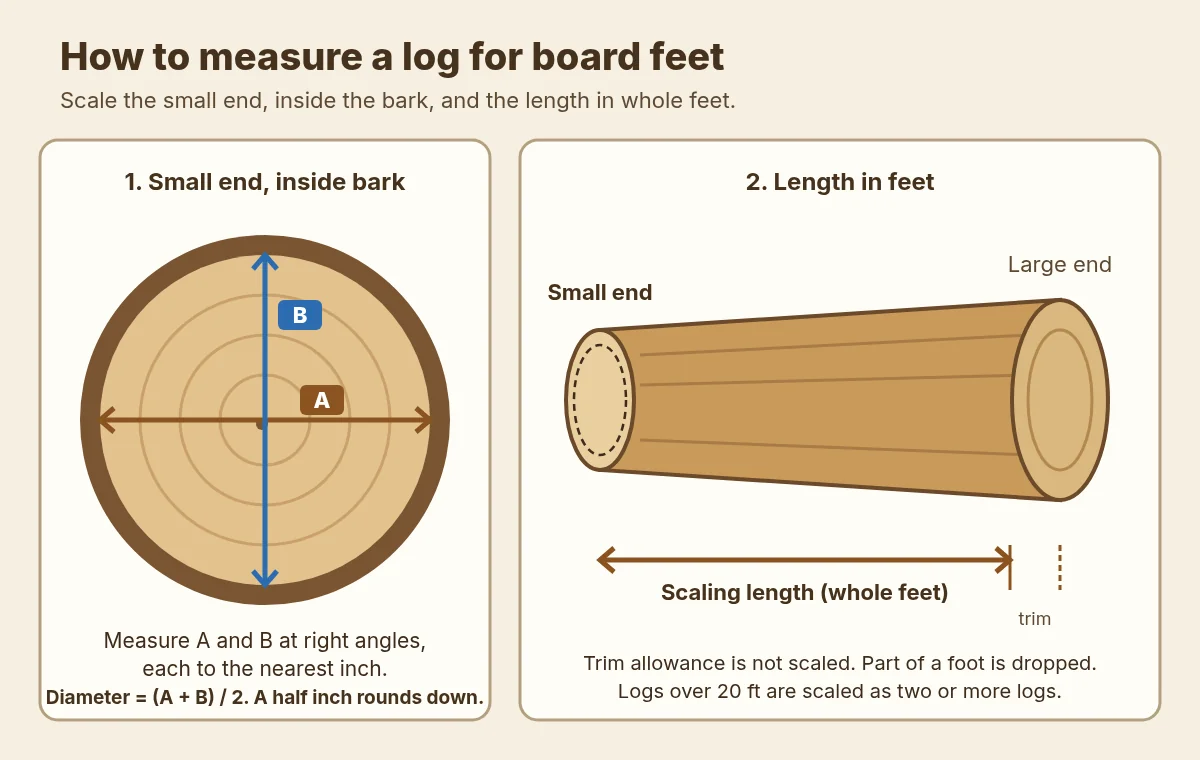
Every log rule is built on two numbers: the diameter inside the bark at the small end and the length in feet. Small errors matter. Purdue Extension describes 14 experienced timbermen who scaled the same 11 logs and came up with 14 different totals.
Diameter: small end, inside the bark
- Measure across the small end, inside the bark, through the true center of the log rather than the pith.
- Skip bumps and hollows, or measure as if they were not there.
- Take a pair of measurements at right angles to each other, each to the nearest inch, and average them.
- If the average lands on a half inch, round down. Readings of 24 and 25 inches average 24 1/2 and scale as a 24 inch log.
These steps follow section 17.3 of the Forest Service National Forest Log Scaling Handbook. Outside-bark readings and large-end readings both make a log look bigger than it scales, because the rules assume the small end without bark.
Length: whole feet, without trim
Logs are cut a little longer than their scaling length because they cannot be bucked perfectly square and the ends get damaged in logging. The Forest Service handbook calls that extra length the trim allowance, and it is not scaled. The maximum trim is set by the contract or the buyer, so ask before you cut. The calculator drops any part of a foot, so 16.9 ft scales as 16 ft.
Logs longer than 20 feet
The International rule is applied to logs up to 20 feet, and Purdue Extension notes that longer logs are scaled as two or more logs. The Forest Service handbook gives standard ways to divide long logs into scaling segments. Scale each segment here and add the results.
Gross scale and net scale
A log rule gives the gross scale of a sound, straight log. The University of Tennessee Extension guide explains that the scaler then deducts for defects such as rot, checks, sweep and crook to reach the net scale, and the log should be valued on the net figure. Use the defect deduction field if you have an estimate.
The three log rules, with formulas and worked examples
In each formula, D is the small-end diameter inside the bark in inches and L is the log length in feet. The worked examples all use the same log, 16 inches by 12 feet, so you can see how far apart the rules land.
Doyle log rule
Board feet = (D − 4)² × L ÷ 16
The Doyle rule subtracts 4 inches from the diameter for slabs and edgings, squares the result and adjusts for length. It ignores taper. Purdue Extension calls it the most widely used rule, especially on private timber in the East and South, and the University of Tennessee guide says it is the most common rule for hardwood log scaling in Tennessee.
Worked example: (16 − 4)² × 12 ÷ 16 = 144 × 12 ÷ 16 = 108 board feet.
The weakness is the fixed 4 inch allowance. It is too large for small logs and too small for large ones, so Doyle under-scales small logs and over-scales large logs. The Tennessee guide adds that Doyle allows only about 4.5 percent of log volume for sawdust and shrinkage, where most rules allow 10 to 30 percent. Below about 8 inches the result is so low that the calculator flags it.
Scribner Decimal C log rule
Scribner is a diagram rule. J. M. Scribner published it in 1846 from drawings of the 1 inch boards that fit inside circles of each diameter, with a 1/4 inch saw kerf and no allowance for taper. The Decimal C form rounds each volume to the nearest 10 board feet and drops the last zero, so a log of 136 to 145 board feet is recorded as 14.
Because it is a table, not a formula, this calculator reads Scribner Decimal C straight from the Forest Service table in Appendix 2 of the scaling handbook for diameters of 6 to 40 inches. For 41 to 60 inches it uses the handbook’s own diameter factors from Appendix 15, which can differ from the printed table by 10 board feet on a few sizes.
If you need a formula, Bruce and Schumacher’s approximation is widely quoted: Board feet ≈ (0.79D² − 2D − 4) × L ÷ 16. Purdue Extension notes that it is fairly consistent on logs of 16 feet or shorter and under 28 inches.
Worked example: the Decimal C table gives 12 for a 16 inch, 12 foot log, which is 120 board feet. The formula gives (0.79 × 256 − 32 − 4) × 12 ÷ 16 = 124.7 board feet, close to the table but not the same.
The step-shaped table explains some odd results. A 10 inch log scales 30 board feet at every length from 8 to 12 feet, a quirk Purdue Extension points out.
International 1/4 inch log rule
Board feet per 4 ft section = (0.22D² − 0.71D) × 0.905, with D increased by 1/2 inch for each 4 ft section, and the total rounded to the nearest 5 board feet.
Judson F. Clark developed the International rule in 1900 for the Province of Ontario with a 1/8 inch kerf, and in 1917 adjusted it for a 1/4 inch kerf. The 0.905 factor makes that adjustment: Purdue lists the 1/4 inch rule for a 4 ft section as 0.199D² − 0.642D, which is the 1/8 inch formula multiplied by 0.905. The rule assumes 1/2 inch of taper in every 4 feet, so each section is figured at a slightly larger diameter than the one before. For lengths that are not a multiple of 4 feet, the calculator adds the leftover feet as a share of the next section, which reproduces the Forest Service table.
Worked example: a 12 foot log has three 4 ft sections at 16, 16.5 and 17 inches. They work out to 40.7, 43.6 and 46.6 board feet, a total of 130.9, which rounds to 130 board feet.
The Forest Service handbook says the International 1/4 inch rule probably gives a closer lumber-volume estimate than other log rules in common use, and both Purdue and Tennessee Extension call it the most accurate of the three.
Doyle vs Scribner vs International: board feet compared
The table shows board feet for 16 foot logs, computed with the same code as the calculator. The last column shows Doyle as a share of International.
| Small-end diameter | Doyle (bf) | Scribner Decimal C (bf) | International 1/4 in (bf) | Doyle as % of International |
|---|---|---|---|---|
| 8 in | 16 | 30 | 40 | 40% |
| 10 in | 36 | 60 | 65 | 55% |
| 12 in | 64 | 80 | 95 | 67% |
| 14 in | 100 | 110 | 135 | 74% |
| 16 in | 144 | 160 | 180 | 80% |
| 18 in | 196 | 210 | 230 | 85% |
| 20 in | 256 | 280 | 290 | 88% |
| 22 in | 324 | 330 | 355 | 91% |
| 24 in | 400 | 400 | 425 | 94% |
| 26 in | 484 | 500 | 500 | 97% |
| 28 in | 576 | 580 | 585 | 98% |
| 30 in | 676 | 660 | 675 | 100% |
| 32 in | 784 | 740 | 770 | 102% |
| 36 in | 1,024 | 920 | 980 | 104% |
| 40 in | 1,296 | 1,200 | 1,220 | 106% |
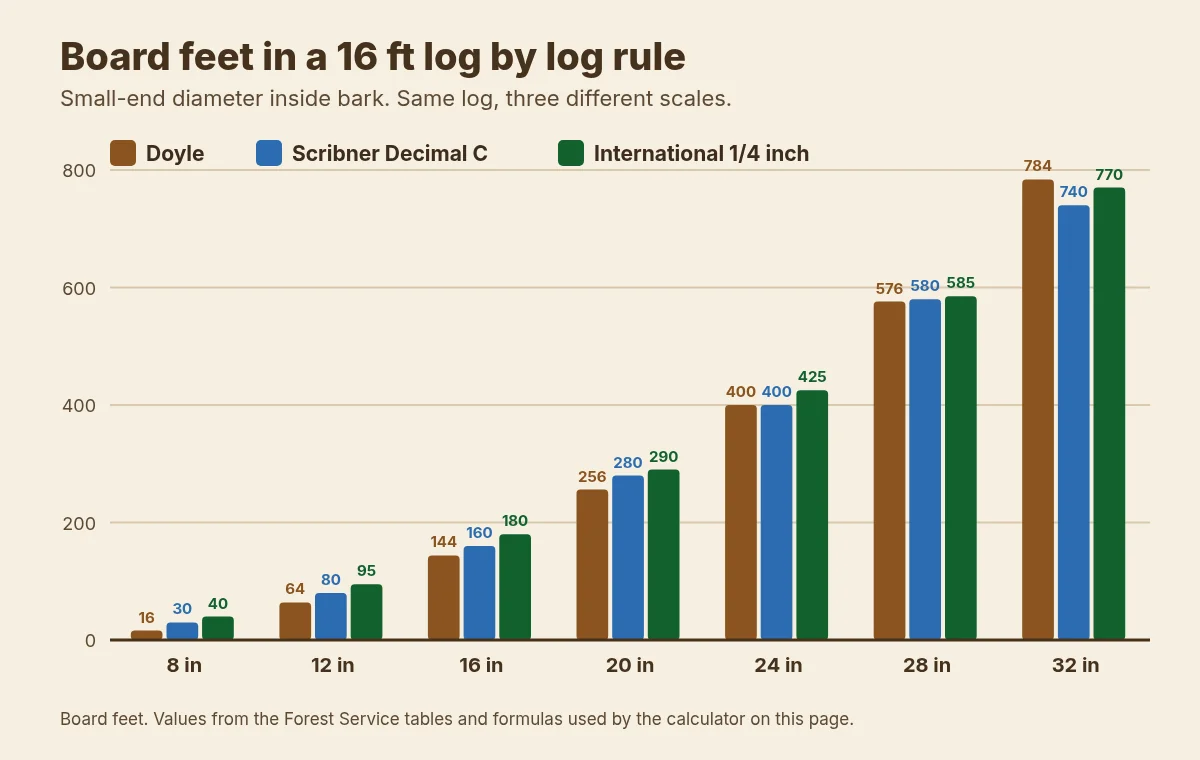
Shorter logs show the same pattern. The next table uses 8 and 12 foot logs, common lengths for hardwood sawlogs.
| Small-end diameter | 8 ft log: Doyle / Scribner / International | 12 ft log: Doyle / Scribner / International |
|---|---|---|
| 10 in | 18 / 30 / 30 | 27 / 30 / 45 |
| 12 in | 32 / 40 / 45 | 48 / 60 / 70 |
| 14 in | 50 / 60 / 65 | 75 / 90 / 100 |
| 16 in | 72 / 80 / 85 | 108 / 120 / 130 |
| 18 in | 98 / 110 / 110 | 147 / 160 / 170 |
| 20 in | 128 / 140 / 135 | 192 / 210 / 210 |
| 24 in | 200 / 210 / 205 | 300 / 300 / 310 |
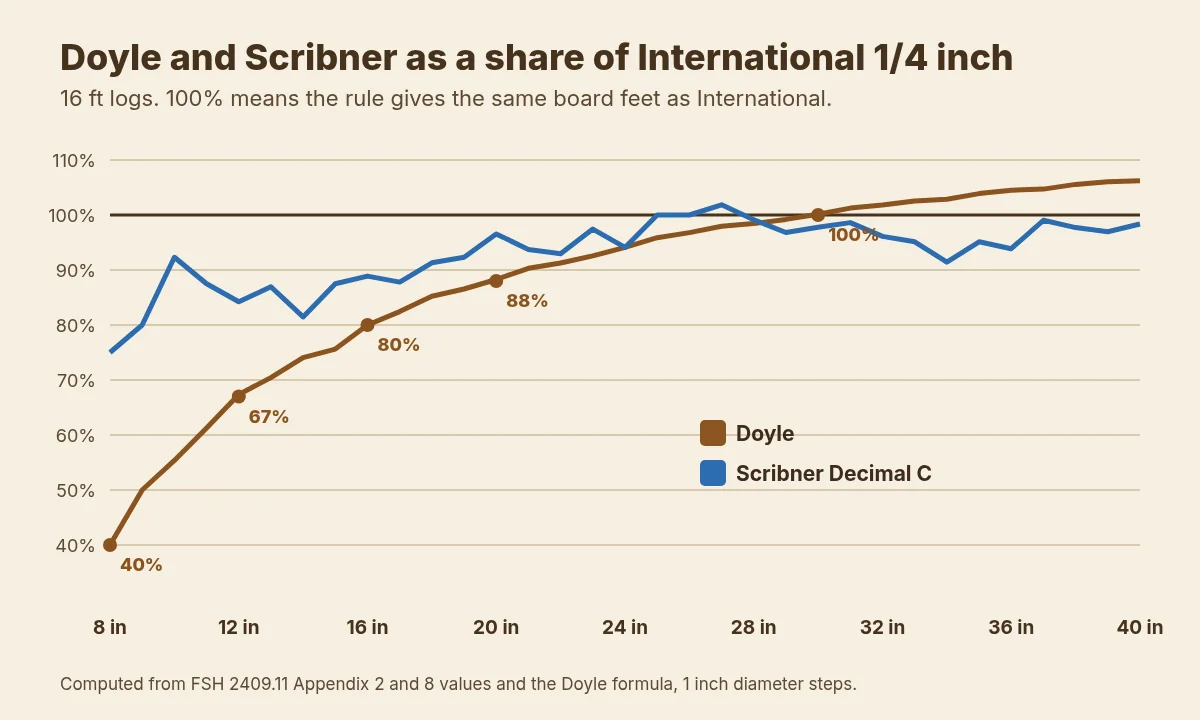
Three things stand out. Doyle gives about 67% of the International figure on a 12 inch log but catches up by about 30 inches, and passes it on larger logs. Scribner Decimal C sits between the two on most small and medium logs. And the International rule moves smoothly with diameter, while Scribner jumps in steps because of its diagrams and rounding.
Which log rule to use, by region and buyer
There is no single correct rule. The one that counts is the one named in the price or the contract. Purdue Extension puts it simply: local tradition usually decides, and the rules are fair as long as everyone uses the same one.
- Doyle: the most widely used rule, especially on private timber in the eastern and southern United States, and the usual rule for hardwood logs in Tennessee.
- Scribner Decimal C: the standard rule for National Forest timber sold by the board foot under 36 CFR 223.36, unless the sale names an International rule. Purdue Extension notes it was widely used by the Forest Service in the Lake States and the West, and the Tennessee guide notes it is common on the West Coast and in the South for pine sawlogs.
- International 1/4 inch: the most accurate of the three. Tennessee Extension says it is generally used in timber sales on eastern national forests and state forests in Tennessee.
Because the rules scale the same logs differently, prices are adjusted to match. The University of Tennessee Extension guide gives these general conversion factors for sawtimber prices:
| To convert a price from | Multiply by |
|---|---|
| Doyle to Scribner | 0.75 |
| Scribner to Doyle | 1.33 |
| Doyle to International | 0.62 |
| International to Doyle | 1.6 |
| Scribner to International | 0.83 |
| International to Scribner | 1.2 |
The calculator’s own table shows why these are only averages. On a 12 inch, 16 foot log Doyle is 67% of International; on a 24 inch log it is 94%. If a buyer quotes in a rule you do not normally use, run your logs through all three columns before you compare offers.
Overrun and underrun
Overrun is the lumber a mill actually saws beyond what the log scale predicted. Purdue Extension gives the calculation as:
Overrun % = (lumber tally ÷ log scale − 1) × 100
For example, a log that scales 144 board feet Doyle and saws out 180 board feet of lumber has an overrun of (180 ÷ 144 − 1) × 100 = 25%. When the lumber tally comes in below the scale, that is underrun.
Overrun depends on the log rule, log size and taper, species, saw kerf, board thickness, edging practice and the sawyer, among other factors. Because Doyle scales small logs so low, they can saw out well above their Doyle scale. The Tennessee guide also notes that most log rules were developed before the 1930s and do not account for thinner kerfs and modern equipment, so they often underestimate what a mill recovers today. Experienced mills know their usual overrun and build it into the price they pay.
Log scale vs lumber yield
A board foot is a piece of wood 1 inch thick, 12 inches wide and 12 inches long, or 144 cubic inches. A log rule estimates how many of those a log will produce. Once the log is sawn, the boards are measured and tallied one by one, and that lumber tally is what you actually have to sell or build with.
To tally sawn lumber, use the board foot calculator for each board or stack. The board foot chart lists common lumber sizes, and the hardwood lumber thickness guide explains quarter sizes such as 4/4 and 8/4.
Worked example: scaling and pricing a small load
Say you have three 14 inch logs 12 feet long and two 18 inch logs 16 feet long. Run each size through the calculator and add the totals:
| Logs | Doyle (bf) | Scribner Decimal C (bf) | International 1/4 in (bf) |
|---|---|---|---|
| 3 logs, 14 in × 12 ft | 3 × 75 = 225 | 3 × 90 = 270 | 3 × 100 = 300 |
| 2 logs, 18 in × 16 ft | 2 × 196 = 392 | 2 × 210 = 420 | 2 × 230 = 460 |
| Total | 617 | 690 | 760 |
| MBF | 0.617 | 0.690 | 0.760 |
At an example price of $400 per MBF, the load is worth $246.80 if that price is quoted Doyle, $276.00 if Scribner and $304.00 if International. The price is only an illustration; use the quote you actually receive. The point is that a price per MBF means nothing until you know which rule it is in.
Frequently asked questions
Related tools
- Board foot calculator: board feet, weight and cost for sawn lumber.
- Board foot chart: board feet for common lumber sizes.
- Hardwood lumber thickness: quarter sizes such as 4/4 and 8/4 explained.
Sources
- USDA Forest Service. FSH 2409.11, National Forest Log Scaling Handbook, WO Amendment 2409.11-2006-1, effective October 30, 2006. Used: chapter 10, sections 14 (authorized log rules, Decimal C rounding, International rule), 17.13 (long logs), 17.15 (odd lengths), 17.2 (trim) and 17.3 (log diameters); Appendix 2 (Scribner Decimal C table), Appendix 8 (International 1/4 inch table and formula) and Appendix 15 (Scribner Decimal C factors).
- Cassens, Daniel. Log and Tree Scaling Techniques (FNR-191). Purdue University Cooperative Extension Service, December 2001. Used: Doyle, Scribner and International formulas and history, Tables 1 to 3, where each rule is used, the overrun formula and factors, log measurement and standing tree methods.
- Bond, Brian. Understanding Log Scales and Log Rules (PB1650). University of Tennessee Extension, revised February 2011. Used: board foot definition, Doyle and Scribner allowances, International 1/4 inch equations, Table 3 comparison, price conversion factors, gross and net scale.
- 36 CFR 223.36, Volume determination. Electronic Code of Federal Regulations, read November 9, 2026. Used: National Forest timber sold on board foot scale is scaled by Scribner Decimal C unless an International 1/4 inch rule is named.
- Kentucky Division of Forestry, 2026 Kentucky Delivered Log Price Report, 1st and 2nd Quarters (July 2026)
- The J Team portable sawmill services page and Skagit Portable Sawmill services page, checked November 20, 2026
Calculator values were checked on November 9, 2026 against every cell of the Forest Service Scribner Decimal C table for 6 to 40 inch logs and against the published Doyle and International 1/4 inch tables in FNR-191.