
Board Foot Calculator for Board Feet, Weight and Cost
Use our free board foot calculator to instantly calculate board feet, lumber weight, and cost. Simply enter thickness (4/4, 6/4, or 8/4), width, length, and quantity to get accurate results. Perfect for lumber yards, woodworking projects, and contractors who need a fast board feet calculator for measuring lumber.
Board Foot Calculator
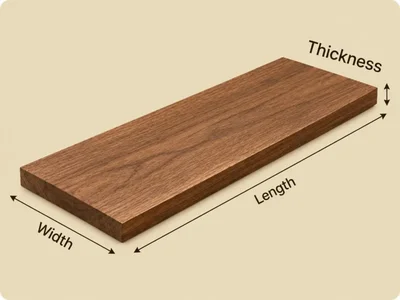
Dimensions & Inputs
How to Use the Board Foot Calculator
- Choose the thickness in quarters of an inch. 4/4 is 1 inch, 6/4 is 1.5 inches and 8/4 is 2 inches.
- Enter the board width in inches.
- Enter the board length in feet.
- Enter how many pieces you need.
- Pick the species to see an estimated weight and cost.
The results show total board feet, the number of pieces, estimated weight and total cost. The price per board foot attached to each species is a sample figure. Real prices change with region, grade, thickness and supplier, so compare the estimate with a quote from your yard before you budget.
If you searched for a bd ft calculator or a board feet calculator, this is the same tool under a different name.
Learn more about this tool and the sources behind it on our About page.
What Is a Board Foot?
A board foot is the volume of a board that is 1 foot long, 1 foot wide and 1 inch thick. That works out to 144 cubic inches, or one twelfth of a cubic foot. The unit is used for lumber in the United States and Canada, and it is written as BF, BDFT or FBM. A thousand board feet is written as MBF.
The key point is that a board foot measures volume, not area. A square foot only describes the surface of a board, while a board foot also counts thickness.
That is why hardwood is priced this way. Sawmills cut hardwood in random widths and lengths, so two boards of the same length can hold very different amounts of wood. A 4/4 board that is 8 inches wide has twice as much wood as a 4/4 board of the same length that is 4 inches wide. Pricing by the board foot keeps the cost proportional to what you actually receive.A board foot calculator like the one above makes this conversion instant, but understanding the formula helps you double-check the result.
Once you know these dimensions, a board foot calculator does this math for you instantly, without needing to remember the formula each time.
Unit | What it measures | Typical use |
|---|---|---|
Board foot | Volume (1 ft x 1 ft x 1 in) | Hardwood, rough lumber, slabs |
Square foot | Area | Flooring, plywood, sheet goods |
Linear foot | Length only | Trim, molding, some dimensional lumber |
How to Calculate Board Feet (Formula)
The standard formula, which the National Hardwood Lumber Association (NHLA) uses in its grading rules, is:
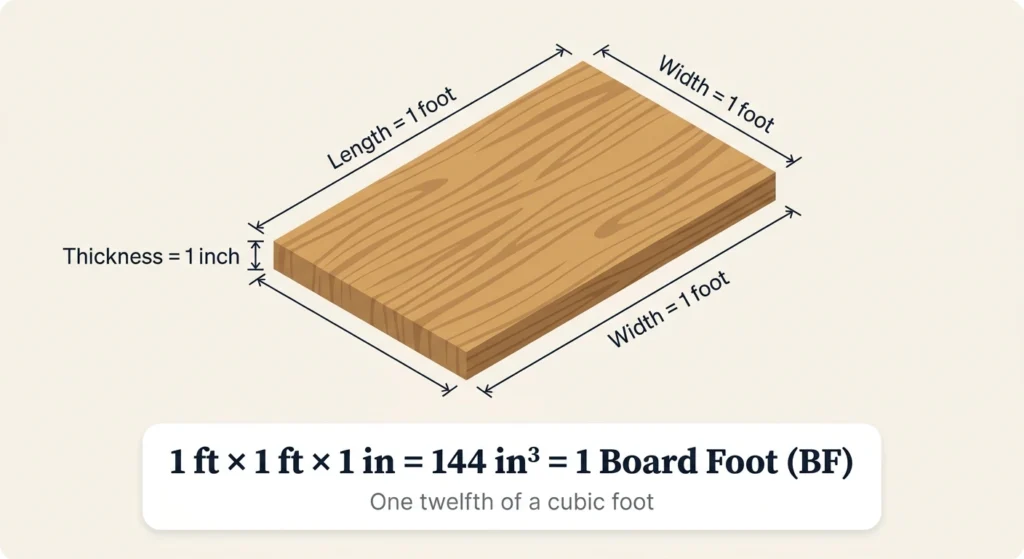
Board feet = thickness (in) x width (in) x length (ft) ÷ 12
If every dimension is in inches, divide by 144 instead:
Board feet = thickness (in) x width (in) x length (in) ÷ 144
Both versions give the same answer. Use the first when you measure length in feet, which is how most lumber is sold.This is the exact formula the board foot calculator above uses to produce its results.
Surface measure shortcut
Surface measure (SM) is the area of a board in square feet: width in inches times length in feet, divided by 12. On 4/4 stock, board feet and surface measure are the same number. For thicker stock, multiply the surface measure by the thickness in inches. A 6/4 board has 1.5 times as many board feet as its surface measure.
Worked example
Say you need six boards of 5/4 stock (1.25 inches thick), each 7 inches wide and 9 feet long.
- One board: 1.25 x 7 x 9 ÷ 12 = 6.56 BF
- Six boards: 6.56 x 6 = 39.38 BF
- Cost a hypothetical $9.00 per BF: 39.38 x $9.00 = $354.38
Hardwood Thickness: The Quarter System
Hardwood thickness is expressed in quarters of an inch, and the figures refer to the rough-sawn size before the board is planed. This is the NHLA convention.
Kiln-dried rough lumber can come in slightly under its label. The NHLA standard kiln-dried rule allows rough stock from 3/8 to 1 3/4 inches thick to be 1/16 inch scant, and stock 2 inches or thicker to be 1/8 inch scant.
Label | Rough thickness | Board feet per sq. ft |
|---|---|---|
4/4 | 1 in | 1.00 |
5/4 | 1.25 in | 1.25 |
6/4 | 1.5 in | 1.50 |
8/4 | 2 in | 2.00 |
10/4 | 2.5 in | 2.50 |
12/4 | 3 in | 3.00 |
16/4 | 4 in | 4.00 |
The hardwood lumber thickness guide lists the surfaced size of each quarter thickness.
Nominal vs. Actual Size: Which Numbers to Use
The answer depends on the type of lumber.
Hardwood is measured on its actual rough dimensions: the real thickness (in quarters), the real width and the real length.
Surfaced softwood, such as construction 2x4s, is usually figured on nominal thickness and width, together with the actual length. The finished sizes of softwood lumber are set by PS 20, the American Softwood Lumber Standard, which is published through the National Institute of Standards and Technology (NIST). Under that standard a 2×4 finishes at about 1.5 by 3.5 inches.
This gap matters for planning. A 2x4x8 counts as 5.33 board feet on nominal dimensions (2 x 4 x 8 ÷ 12). Its real volume is about 3.5 board feet, roughly a third less. If a quote and your own math disagree, check first whether one of you used nominal sizes and the other used actual sizes. When in doubt, ask the supplier which basis they price on.
How Suppliers Tally Board Feet
Lumber dealers follow NHLA measuring rules, which can shift a total slightly compared with a plain calculator:
- Random widths are rounded to the nearest whole inch, and a width that falls exactly on a half inch is rounded up on one board and down on the next.
- Lengths between whole feet are rounded down to the nearest whole foot.
Under those rules, a board 5 1/4 inches wide and 8 1/2 feet long is tallied as 5 inches by 8 feet. Fractions can be entered in the calculator as decimals (12 3/4 inches is 12.75).
On large orders it is worth checking the tally. One hardwood dealer notes that NHLA rules accept a tally variation of up to 4 percent in value, so small differences between your figure and an invoice are not unusual.
See the actual size of every common board in our nominal vs actual lumber sizes chart.
Board Foot Size Chart
4/4 hardwood (1 inch thick)
Width | 6 ft | 8 ft | 10 ft | 12 ft |
|---|---|---|---|---|
4 in | 2.00 BF | 2.67 BF | 3.33 BF | 4.00 BF |
6 in | 3.00 BF | 4.00 BF | 5.00 BF | 6.00 BF |
8 in | 4.00 BF | 5.33 BF | 6.67 BF | 8.00 BF |
10 in | 5.00 BF | 6.67 BF | 8.33 BF | 10.00 BF |
12 in | 6.00 BF | 8.00 BF | 10.00 BF | 12.00 BF |
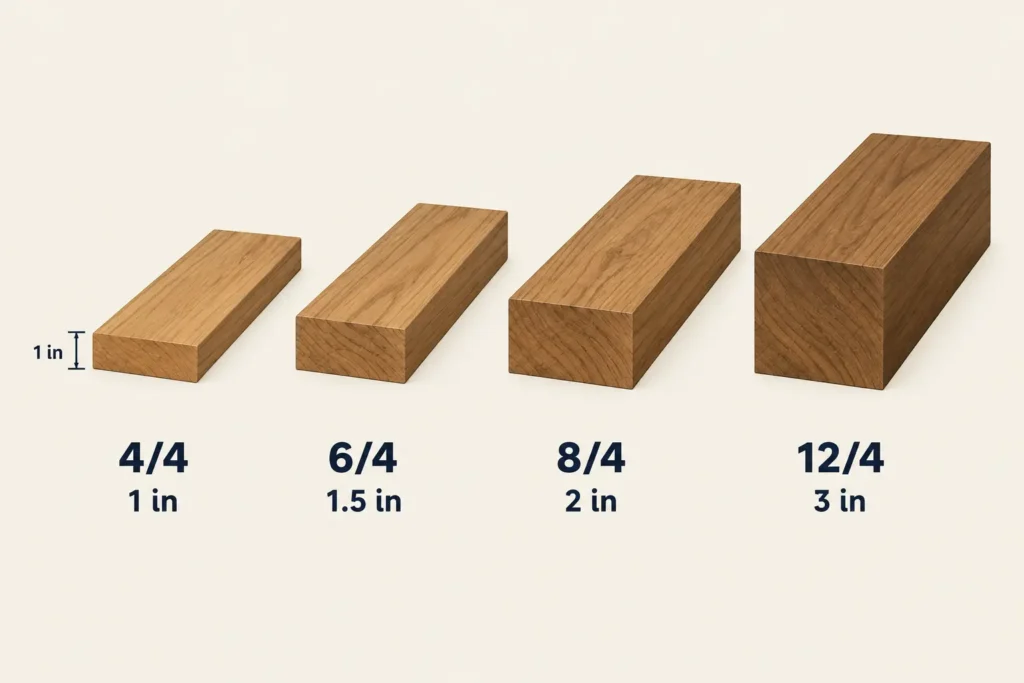
For thicker stock, multiply any value in this chart by the thickness in inches: 1.25 for 5/4, 1.5 for 6/4 and 2 for 8/4.
Softwood 2x lumber (nominal dimensions)
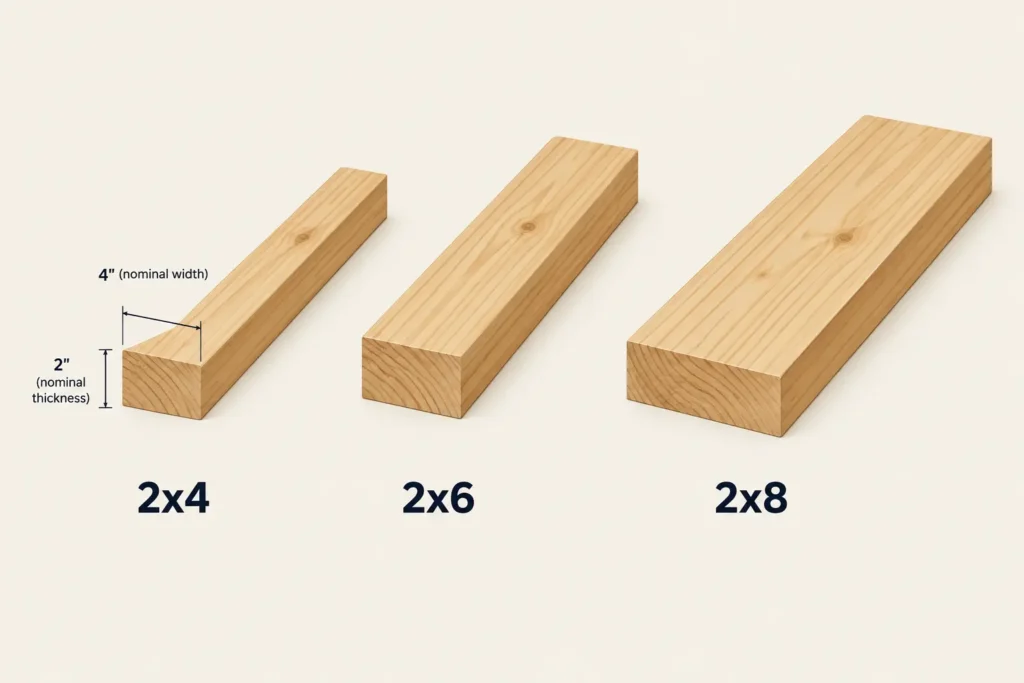
Size | 8 ft | 10 ft | 12 ft |
|---|---|---|---|
2×4 | 5.33 BF | 6.67 BF | 8.00 BF |
2×6 | 8.00 BF | 10.00 BF | 12.00 BF |
2×8 | 10.67 BF | 13.33 BF | 16.00 BF |
2×10 | 13.33 BF | 16.67 BF | 20.00 BF |
2×12 | 16.00 BF | 20.00 BF | 24.00 BF |
See the full board foot chart for more sizes and lengths.
Converting Square Feet and Linear Feet to Board Feet
Square feet and linear feet do not convert directly to board feet, because they leave out one or two dimensions. Once you know the missing measurements, the conversion is simple.
Square feet to board feet: multiply the area by the thickness in inches. 24 sq ft of 1.5-inch stock = 24 x 1.5 = 36 BF.
Board feet to square feet: divide by the thickness in inches. 36 BF at 1.5 inches thick = 36 ÷ 1.5 = 24 sq ft.
Linear feet to board feet: multiply the length by the thickness and width in inches, then divide by 12. 40 linear feet of 1.5 x 5.5 inch stock = 40 x 1.5 x 5.5 ÷ 12 = 27.5 BF.
Board feet to linear feet: multiply by 12, then divide by thickness times width. 27.5 x 12 ÷ (1.5 x 5.5) = 40 linear feet.
Pricing Lumber by the Board Foot
Once you know the volume from the board foot calculator, total cost is simple. Total cost is board feet multiplied by the price per board foot, which is exactly what the board foot calculator does once you enter a price. Wider boards are often priced higher per board foot because fewer wide boards come out of each log.
Larger volumes are sometimes quoted per MBF, meaning per 1,000 board feet. To convert, divide the MBF price by 1,000. A hypothetical price of $900 per MBF is $0.90 per board foot. Going the other way, an 18-foot 2×6 contains 18 board feet, which is 0.018 MBF.
Estimating the Weight of Lumber
Because one board foot is one twelfth of a cubic foot, you can estimate weight from the species density:
The board foot calculator above estimates weight automatically once you pick a species, using the formula below.
Weight (lb) = board feet x density (lb/ft³) ÷ 12
Density depends on species and moisture content. The Wood Database standardizes its figures at 12 percent moisture, the level wood reaches in a typical indoor environment. For oak, which ranges from 37 to 56 lb/ft³, a single board foot weighs somewhere between 3.08 and 4.67 pounds. As a simple example, 60 BF of a species at 36 lb/ft³ weighs about 180 pounds.
Freshly cut lumber can weigh more than double its oven-dry weight, so treat any estimate for green wood as a minimum.
Board Feet in a Log
The calculator above is built for sawn lumber. Logs are measured differently, using log rules that estimate how much lumber a log will yield after sawing.
To scale a log, measure the diameter at the small end inside the bark and the length in feet. The Doyle rule then gives:
Board feet = ((diameter – 4) ÷ 4)² x length
For a log 16 inches across at the small end and 12 feet long:
((16 – 4) ÷ 4)² x 12 = 9 x 12 = 108 BF.
The three log rules most used in the United States give different answers for the same log:
- Doyle is a simple formula that deducts 4 inches from the diameter. University of Tennessee Extension notes that its allowance for slabs and edgings is too large for small logs and too small for large ones.
- Scribner is based on diagrams of 1-inch boards with a 1/4-inch saw kerf allowance. It does not account for taper, so it underestimates logs longer than 16 feet.
- International 1/4-inch is a formula-based rule developed around 1906.
Before you buy or sell logs, confirm which rule the other party uses. The same log can scale at noticeably different volumes under each one.
Tips for Planning a Lumber Purchase
Keep these points in mind when you use the board foot calculator to plan a purchase:
- Start from the rough thickness you will buy, not the finished thickness. A 3/4-inch tabletop is typically milled from 4/4 stock.
- Keep length in feet when you use the ÷ 12 formula, and width and thickness in inches.
- Add an allowance for defects, trimming and mistakes. A margin of 10 to 15 percent is a common rule of thumb, and complex projects may need more.
- Use decimals for fractions, so 8 1/4 inches becomes 8.25.
- Check whether a quote uses nominal or actual dimensions before comparing prices.
How Many Board Feet Are in a 2x4x8?
A 2×4×8 holds 5.33 board feet. Here’s the math: (2 × 4 × 8) ÷ 12 = 5.33. Lumber stores charge you for the full 2×4 size, even though the real board is a bit smaller (1.5″ × 3.5″) after the mill smooths it down. That smoothing is why the tag size and the real size don’t match.
How to Convert Board Feet to Square Feet
To get square feet, divide your board feet by the thickness in inches. Example: 200 board feet of 2-inch-thick wood covers 100 square feet. If the wood is 1 inch thick, both numbers are the same.
What Does MBF Mean in Lumber?
MBF means 1,000 board feet — M stands for thousand. Mills that cut lots of wood use it for bulk prices. If oak costs $800 per MBF, that’s 80 cents per board foot.
Frequently Asked Questions
Sources
- American Hardwood Export Council, Grading sawn lumber: measurement
- NHLA Rules for the Measurement and Inspection of Hardwood and Cypress, rules card
- NIST, Voluntary Product Standard PS 20-20, American Softwood Lumber Standard
- University of Tennessee Extension, Understanding Log Scales and Log Rules (PB 1650)
- The Wood Database, Average Dried Weight