
Board Feet to Square Feet Calculator
Convert board feet to square feet, or square feet to board feet, for lumber of any thickness. Pick a quarter size such as 4/4 or 8/4 or type your own thickness, enter the amount, and the calculator shows the result with the formula and a worked line. You can also allow for waste and convert a price per board foot into a price per square foot.
Board feet measure volume and square feet measure area, so the conversion always needs the thickness. At 1 inch thick the two numbers are the same. At 2 inches, the same board feet cover half the area.
Board Feet to Square Feet Calculator
Quick check: 1 square foot of face
| Thickness | Board feet | Sq ft per board foot |
|---|---|---|
| 4/4 (1 in) | 1 | 1 |
| 5/4 (1.25 in) | 1.25 | 0.8 |
| 6/4 (1.5 in) | 1.5 | 0.67 |
| 8/4 (2 in) | 2 | 0.5 |
| 12/4 (3 in) | 3 | 0.33 |
Use the thickness the lumber is sold by: quarter size for hardwood, nominal size for softwood.
Lumber thickness & amount
–
| Board feet | – |
|---|---|
| Square feet of face | – |
| After waste | – |
| Cubic feet (board feet / 12) | – |
| Price per board foot | – |
| Price per square foot | – |
| Estimated cost | – |
| Cost per sq ft covered | – |
How to use the calculator
- Choose the thickness. The list covers 4/4 to 16/4. For anything else, choose Custom thickness and type a decimal or a fraction such as 0.75, 3/4 or 1-1/8.
- Enter the amount and pick its unit: board feet or square feet. The result is shown in the other unit.
- Optionally enter a waste percentage. With board feet entered, the calculator shows the area you can still cover. With square feet entered, it shows how many board feet to buy.
- Optionally enter a price per board foot or per square foot. You get both prices and an estimated cost.
- Check the formula line under the result, then use Copy result to save it or Reset to start again.
If you need board feet from the length, width and thickness of boards, use the board foot calculator on the home page instead. This page only converts between board feet and square feet.
Board feet to square feet formula
Square feet = board feet ÷ thickness in inches
A board foot is a piece of wood 1 foot long, 1 foot wide and 1 inch thick, which is 144 cubic inches. That definition appears in NIST Handbook 130 and in the wood extension fact sheet from the University of Wisconsin. One square foot of face at 1 inch thick is therefore exactly 1 board foot. Each extra inch of thickness puts another board foot behind the same square foot, so you divide by the thickness to get back to area.
Use the thickness in inches, not feet. Dividing by the thickness in feet gives an answer 12 times too large, which is a mistake some online converters make.
200 board feet to square feet
200 board feet covers 200 square feet at 1 inch (4/4), 160 square feet at 5/4, 133.33 square feet at 6/4 and 100 square feet at 8/4. For 8/4 lumber the working is 200 ÷ 2 = 100 square feet.
360 board feet to square feet
360 board feet covers 360 square feet at 1 inch, 288 square feet at 5/4 (360 ÷ 1.25), 240 square feet at 6/4 and 180 square feet at 8/4.
Square feet to board feet formula
Board feet = square feet × thickness in inches
This is the same formula run backwards. To cover 240 square feet with 5/4 lumber you need 240 × 1.25 = 300 board feet, before any allowance for waste. With 1 inch lumber the board feet and square feet are equal, so 500 square feet of 4/4 is 500 board feet.
| Square feet | 4/4 (1 in) | 5/4 (1-1/4 in) | 6/4 (1-1/2 in) | 8/4 (2 in) | 12/4 (3 in) |
|---|---|---|---|---|---|
| 100 sq ft | 100 bf | 125 bf | 150 bf | 200 bf | 300 bf |
| 200 sq ft | 200 bf | 250 bf | 300 bf | 400 bf | 600 bf |
| 500 sq ft | 500 bf | 625 bf | 750 bf | 1,000 bf | 1,500 bf |
| 1,000 sq ft | 1,000 bf | 1,250 bf | 1,500 bf | 2,000 bf | 3,000 bf |
How many board feet are in a square foot?
The board feet in one square foot of face equal the thickness in inches. A square foot of 4/4 lumber is 1 board foot, a square foot of 5/4 is 1.25 board feet, and a square foot of 8/4 is 2 board feet. Turned around, one board foot covers 1 ÷ thickness square feet.
| Quarter size | Thickness (in) | Board feet per sq ft | Sq ft per board foot | Hardwood surfaced S2S (in) | Softwood dressed dry (in) |
|---|---|---|---|---|---|
| 4/4 | 1 | 1 | 1 | 13/16 | 3/4 |
| 5/4 | 1.25 | 1.25 | 0.8 | 1-1/16 | 1 |
| 6/4 | 1.5 | 1.5 | 0.67 | 1-5/16 | 1-1/4 |
| 7/4 | 1.75 | 1.75 | 0.57 | 1-1/2 | not listed |
| 8/4 | 2 | 2 | 0.5 | 1-3/4 | 1-1/2 |
| 10/4 | 2.5 | 2.5 | 0.4 | 2-1/4 | 2 |
| 12/4 | 3 | 3 | 0.33 | 2-3/4 | 2-1/2 |
| 14/4 | 3.5 | 3.5 | 0.29 | 3-1/4 | 3 |
| 16/4 | 4 | 4 | 0.25 | 3-3/4 | 3-1/2 |
Board feet vs square feet
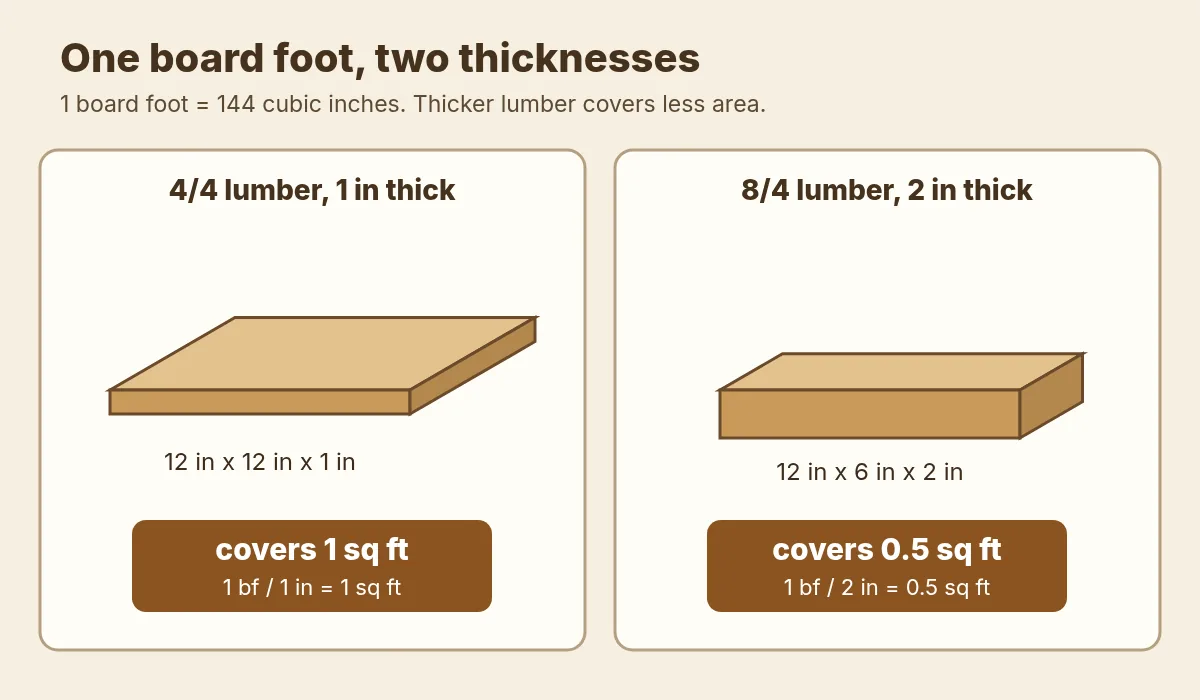
A board foot is a unit of volume. A square foot is a unit of area. Lumber is sold by volume because a thicker board holds more wood, and the price follows the wood. Floors, walls, decks and tabletops are planned by area. The thickness links the two.
- 1 board foot = 144 cubic inches = 1/12 of a cubic foot, so 12 board feet make 1 cubic foot.
- 1 square foot = 144 square inches of face, with no thickness at all.
- At 1 inch thick, 1 board foot covers 1 square foot. At any other thickness the numbers differ.
Hardwood has one more term that looks like square feet: surface measure. NIST Handbook 130 defines it as the width of a board in inches times its length in feet, divided by 12 and rounded to the nearest whole square foot. It is used for grading and tallying, and it ignores thickness. The handbook also lets retailers sell surfaced hardwood in stock widths by surface measure in square feet, as long as the thickness is stated. Multiply surface measure by the thickness in inches to get board feet.
Which thickness to enter: nominal, quarter or actual
Enter the thickness the lumber is sold by, not the thickness you measure after planing. Both lumber standards count board feet that way:
- Softwood. The American Softwood Lumber Standard, PS 20-25, works out board feet from the nominal thickness and width. A 2×6 counts as 2 inches thick even though Table 3 of the standard lists it as 1-1/2 by 5-1/2 inches dry.
- Hardwood. Hardwood is sold rough in quarter-inch thicknesses: 4/4 is 1 inch, 5/4 is 1-1/4 inches, 8/4 is 2 inches. The USDA Wood Handbook lists the standard surfaced (S2S) sizes in Table 6-4, for example 13/16 inch for 4/4 and 1-3/4 inches for 8/4. Grading rules tally board feet on the quarter sizes. If you buy surfaced hardwood, ask whether the tally was taken before or after surfacing: NIST Handbook 130 says random-width hardwood measured after kiln drying is sold on net board footage, with no footage added back for drying shrinkage or surfacing.
The calculator shows both surfaced sizes under the thickness box when you pick a quarter size, as a reminder not to enter them. The nominal vs actual lumber sizes page and the hardwood lumber thickness guide have the full tables.
If you want the true volume of wood in surfaced boards, for a weight or shipping estimate, enter the actual thickness as a custom value. The University of Wisconsin fact sheet gives this example: a 2×6 measured at its actual 1-1/2 by 5-1/2 inches holds less wood than its nominal board feet suggest. Just remember that a dealer will bill on the nominal or quarter size.
Lumber thinner than 1 inch
Lumber rules do not scale board feet down for thin stock. The NHLA measurement rules, in the cypress section published by the Cypress Lumber Association, say that for lumber under 1 inch thick the board feet are based on surface dimensions. The 2025 NLGA rules for Canadian softwood say the same in paragraph 26, and the federal softwood lumber checkoff definition in 7 CFR 1217.4 states that softwood under 1 inch nominal is calculated as 1 inch. In each case, board feet and square feet come out equal.
The calculator does this by default when you enter a thickness under 1 inch. Untick the box if you want the geometric volume instead: 100 board feet of 1/2 inch stock is then 200 square feet rather than 200. The PS 20-25 wording (“nominal thickness in inches or fraction of an inch”) does not spell out a thin-stock rule, so if a softwood quote matters, ask the seller which way they count.
Coverage: what 100, 200 or 500 board feet will cover
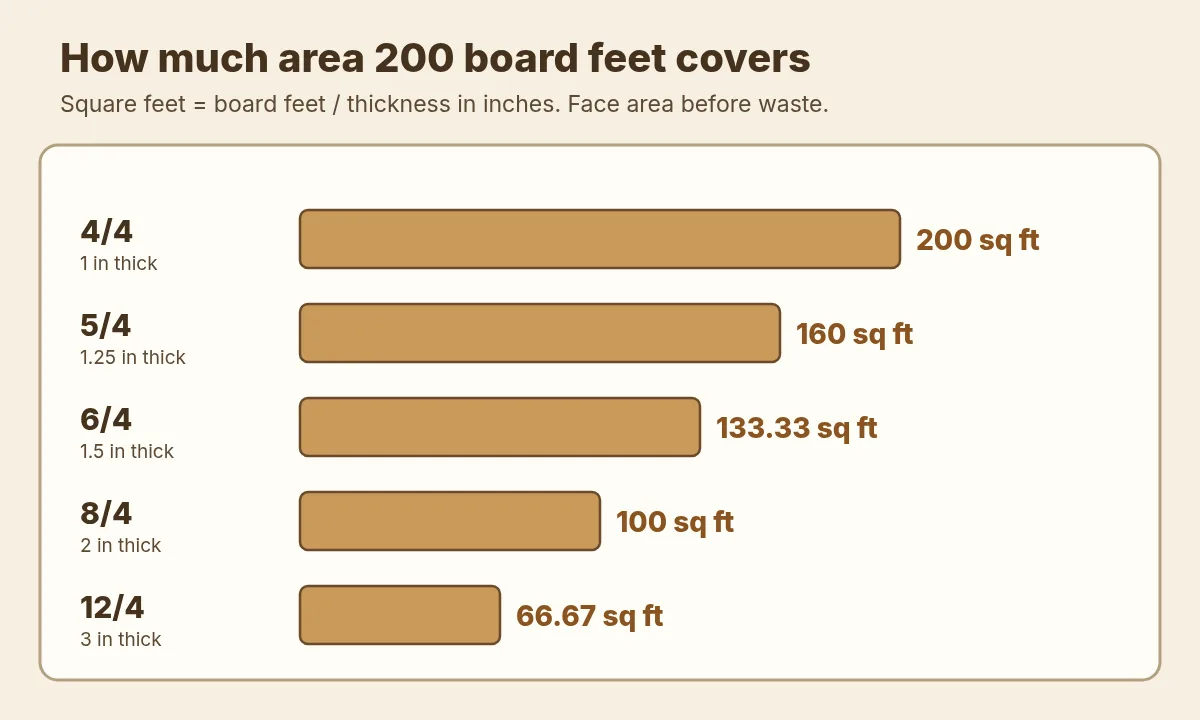
| Board feet | 4/4 (1 in) | 5/4 (1-1/4 in) | 6/4 (1-1/2 in) | 8/4 (2 in) | 12/4 (3 in) |
|---|---|---|---|---|---|
| 100 bf | 100 sq ft | 80 sq ft | 66.67 sq ft | 50 sq ft | 33.33 sq ft |
| 200 bf | 200 sq ft | 160 sq ft | 133.33 sq ft | 100 sq ft | 66.67 sq ft |
| 240 bf | 240 sq ft | 192 sq ft | 160 sq ft | 120 sq ft | 80 sq ft |
| 360 bf | 360 sq ft | 288 sq ft | 240 sq ft | 180 sq ft | 120 sq ft |
| 500 bf | 500 sq ft | 400 sq ft | 333.33 sq ft | 250 sq ft | 166.67 sq ft |
| 1,000 bf | 1,000 sq ft | 800 sq ft | 666.67 sq ft | 500 sq ft | 333.33 sq ft |
These figures are face area at full nominal width. Real coverage is usually lower, for the reasons below.
Flooring, paneling and siding: face width is narrower
Tongue-and-groove and shiplap boards lose part of their width to the joint, and every surfaced board is narrower than its nominal width. Board measure still uses the nominal width, so the square feet of visible face per board foot drop. PS 20-25 Table 1 lists the face widths for softwood flooring. Here is what those widths mean for 100 board feet of nominal 1 inch flooring:
| Nominal width (in) | Face width (in) | Face as % of nominal | Sq ft of face per 100 bf |
|---|---|---|---|
| 2 | 1-1/8 | 56.3% | 56.3 |
| 3 | 2-1/8 | 70.8% | 70.8 |
| 4 | 3-1/8 | 78.1% | 78.1 |
| 5 | 4-1/8 | 82.5% | 82.5 |
| 6 | 5-1/8 | 85.4% | 85.4 |
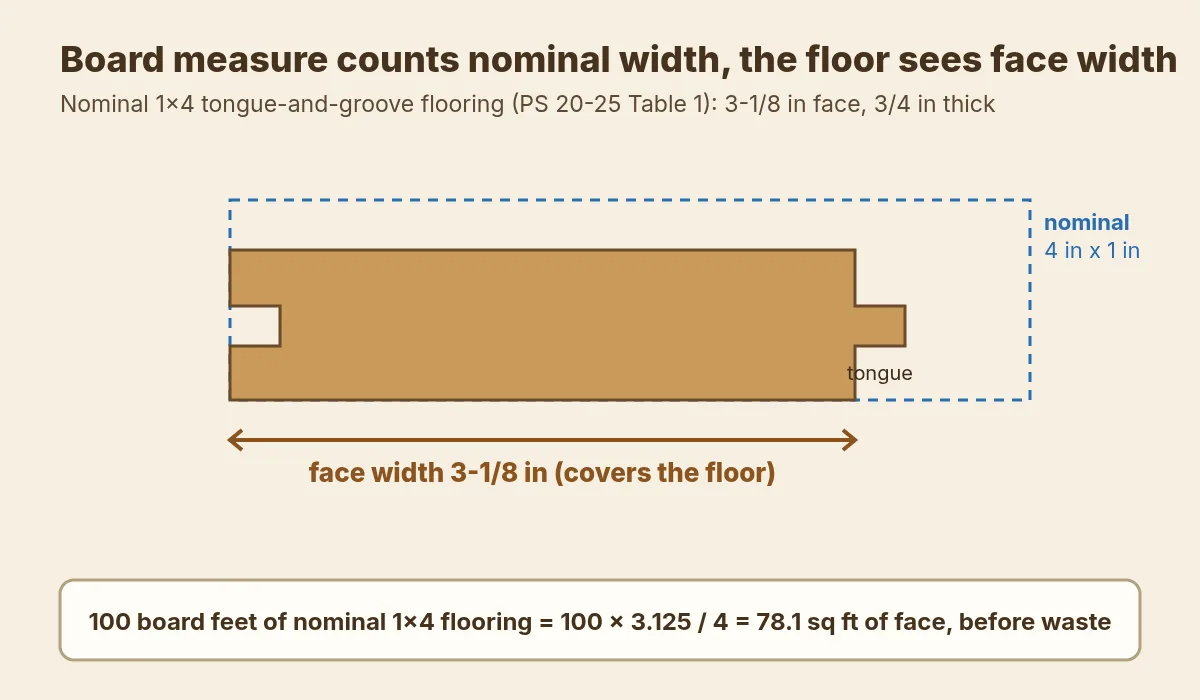
If your flooring or paneling is already quoted by the square foot of coverage, you do not need this conversion. Use it when the quote is in board feet.
Decking
If decking is quoted in board feet, the same width problem applies. Take nominal 5/4 x 6 boards. PS 20-25 Table 3 lists a nominal 1-1/4 inch thickness as 1 inch dressed and a 6 inch width as 5-1/2 inches dry. 100 board feet is 160 linear feet of 5/4 x 6, which gives about 73.3 square feet of board face before the gaps between boards. That is less than the 80 square feet a simple 100 ÷ 1.25 suggests, because the boards are narrower than 6 inches.
Allowing for waste
Some lumber is always lost to end trimming, defects, knots you cut out and offcuts. How much depends on the grade, the board lengths and the layout, so there is no single correct figure. Use your own records, or ask the supplier or installer for theirs.
In the calculator, waste is the share of the lumber you buy that does not end up in the job. That makes the two directions consistent:
- Board feet to square feet: coverage = square feet × (1 − waste %).
- Square feet to board feet: board feet to buy = board feet needed ÷ (1 − waste %). For 90 square feet of 4/4 with 10% waste, that is 90 ÷ 0.9 = 100 board feet.
Adding 10% on top (90 × 1.1 = 99) gives slightly less. The difference grows with higher waste rates.
Price per board foot and price per square foot
Prices convert with the same thickness factor:
- Price per square foot = price per board foot × thickness in inches
- Price per board foot = price per square foot ÷ thickness in inches
So if 8/4 lumber costs P per board foot, one square foot of it costs 2P. If 5/4 boards are quoted at S per square foot, that is S ÷ 1.25 per board foot. Enter your own quote in the price box. This page does not list market prices, because they vary by species, grade, region and date.
Common mistakes
- Using thickness in feet. Divide board feet by inches of thickness. Dividing by feet makes the area 12 times too big.
- Entering the planed thickness. A 2×6 is 2 inches thick for board feet, not its dressed 1-1/2 inches.
- Treating board feet as area. 200 board feet only covers 200 square feet at 1 inch thick.
- Ignoring the face width. Tongue-and-groove and shiplap boards cover less than their nominal width.
- Mixing up cubic feet. 1 cubic foot is 12 board feet, not 1.
Frequently asked questions
Related tools
- Board foot calculator: board feet, weight and cost of sawn lumber from its dimensions.
- Board foot chart: board feet for common lumber sizes and lengths.
- Hardwood lumber thickness: quarter sizes such as 4/4 and 8/4, rough and surfaced.
- Nominal vs actual lumber sizes: why a 2×4 measures 1-1/2 by 3-1/2 inches.
- Log board foot calculator: board feet in a log by the Doyle, Scribner and International rules.
Sources
- National Institute of Standards and Technology. NIST Handbook 130 (2026), IV.B Uniform Regulation for the Method of Sale of Commodities, read November 12, 2026. Used: 2.12.1.1 board foot definition, 2.12.1.4 surface measure, 2.12.3.1 sale of surfaced hardwood by surface measure with thickness stated, 2.12.4.1 random-width hardwood sold on net board footage.
- National Institute of Standards and Technology. Voluntary Product Standard PS 20-25, American Softwood Lumber Standard, read November 12, 2026. Used: 2.2 board measure on nominal size, 2.16 nominal size, Table 1 flooring face widths, Table 3 dressed sizes.
- Senalik, C. Adam and Farber, Benjamin. Chapter 6, Commercial Lumber, Round Timbers, and Ties, in Wood Handbook, FPL-GTR-282. USDA Forest Service, Forest Products Laboratory, 2021. Read November 12, 2026. Used: Table 6-4 standard rough and surfaced hardwood thicknesses; nominal and actual sizes; purchase considerations.
- National Hardwood Lumber Association. Rules for the Measurement and Inspection of Hardwood and Cypress, effective January 1, 2019 (cypress section as published by the Cypress Lumber Association). Read November 12, 2026. Used: paragraph 6, board measure for lumber under 1 inch based on surface dimensions; paragraph 13, standard thicknesses in quarters.
- National Lumber Grades Authority. Standard Grading Rules for Canadian Lumber, 2025 edition, effective September 1, 2025. Read November 12, 2026. Used: paragraphs 23 to 26, board measure on nominal dimensions and thin lumber.
- 7 CFR 1217.4, Board foot. Electronic Code of Federal Regulations, read November 12, 2026. Used: softwood board feet on nominal size; under 1 inch counted as 1 inch.
- Martin, A. Jeff. What Is a Board Foot? (Forestry Facts No. 42). University of Wisconsin Extension, August 1989. Read November 12, 2026. Used: board foot definition and formula, nominal versus actual volume of a 2×6.
Every number in the tables on this page was produced by the same code the calculator runs, and checked by automated tests on November 12, 2026.